
UAS News Podcast — 2012-05-16
Audio not available on SoundCloud — full transcript below.
Transcript
Hi everyone, And welcome to this channel. Alright, hello everyone and welcome to the second installment of the UAS News Podcast. I have to say that we've had a lot of positive feedback about last week's cast with Gene Robinson and talking about SAR and small UAS. And so me and Gary decided that we would ask Gene back and actually I think we're going to, Gene's going to be my co-pilot on this endeavor, the podcast.
We had a good conversation last week. I think we scratched the surface. What would you say Gene?
Oh yeah, definitely. That was a very good first go at the podcast and I think we've got plenty more to go. Yeah, I think we've got a ton. We probably could have went on about the SAR thing for another hour, at least, without running out of material.
But you know, when your book comes out I think we'll revisit that and go into that some more. Today we have Chris McNair and Jimmy Prudy and they are our guests and we're going to talk about this thing they did with the Sea Shepherd. But first I want to get into, we've got an extra long show today, we're going 45 minutes, but I want to get into some of the breaking news. And the breaking news today is the press release that the FAA put out about how they've streamlined the COA process.
And you'll be seeing these drones everywhere. And I've got to be honest with you, I'm not really seeing anything here. And maybe I only gave it the first read, I'm a little bit of a slow learner, and I've got to read it a couple of times. But I'm not seeing anything to toot the horn about, Gene?
No, I really don't think so either, Patrick. I think that we're getting a little spin-doctering. The COA process has been out for a while and if you do go through all the hoops and got all the I's and crossed all the T's, you can eventually get to fly. But I think that process is still in place and they really have just tried to make it seem that it's something new and that anyone can apply for it.
You're not seeing, you know, it's not all free and easy like it was made out, huh? No, I really don't see that. I mean, obviously the requirements are still going to be there. There's going to have to be a pilot or at the very least go to ground school, second class medical.
A lot of those things are still going to apply. It's not like we can use our driver's license to prove that we have 20-20 vision. What we'd always hoped for is that with the self-certification process. Yeah, kind of like the light sport aircraft thing, you know, with the driver's license and the last refuge of those going blind.
I don't want to get too far into that one, but I do, I also wanted to talk about, you know, they're touting the interface on the website, you know, I'm going to sign up for the COA. Now, didn't you have something to do with that?
Yeah, a long time ago, working with Randy Willis who is in the FAA now and has been an interim manager there for some several positions, I do believe. But I worked with him since I did have a programmer background to kind of work some of the bugs out over one very long weekend years ago to get the COA process to where it would flow smoothly and not run into any hiccups or bugs. So yeah, I was like in one of the very first beta tests that went through on that one. At the time it seemed okay, but obviously it seems to have expanded to include so much more than it has when we first started.
The streamlining, I'd have to say that if it has remained the same, it's not going to be much different. You still have to fill out all the paragraphs. But my last COA was just approved here a couple weeks ago and I haven't started another in the process, so I really can't speak to the streamlining that they say is there. Well, I think there's, you know, there's probably a little bit of a room for improvement with the six to nine month thing.
You can have a baby or get a COA, you know. You know, the other reason I kind of wanted to bring that up is also, you know, go back to kind of the old guard and how long we've been around this thing and, you know, have offered to assist the FAA in every which way possible, which will probably be in the RKAPA skeletons in the closet show or, you know, I'm also people were suggesting that maybe I do a, maybe we could do one of these, you know, you can call in and ask about anything shows and we'll have to limit it to unmanned aircraft.
I'm not properly trained for anything else, but I think that might be good. We could also get some perspective there. Okay. Well, we're going to move along and we'll start with our two guests.
I have the distinct pleasure of welcoming today's two guests. We've got Chris McNair from Autopilot and Jimmy Prudy from Hangar 18. I know both Chris and Jimmy. I remember the kickoff of Hangar 18 a few years back and I think there were some other people involved.
And so I guess the best thing to do is we'll start off and we'll start off with Jimmy. Maybe you can tell us or tell the audience a little bit about yourself, a little bit of a background, and, you know, we'll go from there. Okay, Patrick. Just like a lot of people in this industry, I started flying RC back in the 70s and Air Force spent 20 years in the intelligence community in the Air Force.
While I was doing that, I taught myself how to design and build airplanes, composite fabrication and whatnot. I retired from the Air Force in 99 and started delving into it at that point in the UAV side. The first aircraft I designed was the Vector P, which was when I was with the IntelliTech Microsystems out in Maryland. We parted ways about a year later and came back to Wichita, Kansas here and started Henry 18 in 2006, first airplane that we came out with.
Of course, it was the Osprey, which is the one that's getting a lot of notoriety right now. And then we've been working with Chris McNamara, an autopilot there with the FOMARU and a couple of projects he's working on. Right now we're really just waiting to see which way the FAs are going to go to see if we can get things to really take off for us. But it's been an interesting ride.
Yeah, well, you had to say the least, being one of the old guard. All right. And then Chris, would you please do the same for us?
Absolutely. Well, as most may know, we started back in right around 2007 with autopilot. I've been in this business since right around 1999, 2000, when I got into the on-man side. Our primary goal is to produce quality aircraft and systems that are feasible for the average individual to purchase and utilize to create a job and or multiple jobs and as simple as a hobby.
I was fortunate enough to team up with Dean Getty of autopilot back in 2007. And we have been working together on the development of the autopilot autopilot. And fortunately, we were given the position to be able to supply him with his marketing sales distribution and relieve him of those duties. All in all, everything has been working well.
But as we were talking here, the regulations and proposed rules have put a bind in just about everybody's plan. And so we're going to have to. You have ITAR to deal with as well, don't you?
Absolutely. ITAR was actually our biggest problem. Seventy percent of our potential sales are overseas. And that's largely due to the lack of regulations in the U.S.
But it also became quite an issue because the government for some reason feels that we have a superior item to other individuals in the world. And that's definitely not the case. So they have inhibited us from being successful or largely successful in that realm. And it has cost multiple people a large amount of money.
Just a matter of them realizing or getting to the position where we can sell relatively freely through the world and use our brains when it comes down to the individual countries that we maybe saw, more specifically, Iran, Afghanistan, Iraq, North Korea, those types of countries that we just claim we'll not sell to. So the ITAR thing has been quite a pain in the rear, but we may have to work around it with them. And it has been picking up lately. Well, that is kind of funny, too.
It's not funny, but the ITAR thing and being an American business or a U.S.-based business, and people have asked me over the last few years, well, what can I do to increase business? I have to tell them, move offshore?
Yeah. Got you pretty well hemmed in here. It's like, well, okay, there's no legal market in the U.S., and then I got this ITAR thing to deal with. And for anyone who hasn't dealt with that ITAR thing, it can be a nightmare.
Your product has to be controlled when it's overseas. It's like in the briefcase, handcuffed to your wrist. I don't know if it's quite that net. It's actually like there's a – we're our worst enemy as far as the United States and developing business, because we have the FAA stepping on us on one side, and ITAR regulations that only the United States follows stepping on us on the other side.
It's just an amazing way to survive it all. Yeah, well, you know, it makes for hard-to-find-income streams. I think that would probably be a fair way to surmise that one. It's a difficult thing.
You know, I don't know. I really – I'm hoping something breaks loose here soon. I know I'd consider both of you guys, too, to be part of the old guard. And, you know, hanging on and waiting for regulation and all of that is very challenging, I'm sure.
I'm sure, you know, and I want to get feedback kind of at the end of this thing, too, if we have time from everyone on the call. And, you know, give you guys an opportunity to say, you know, if X, Y, and Z, then at least I could survive, you know. And then maybe talk about your unicorn scenario where it'd be like, oh, if all this happened, it'd be great and I could make a living and all this would happen. But let's circle back on that.
Let's stick to today's topic first, which is I want to talk about both of your involvement with the Sea Shepherd effort. And, you know, again, you know, we're going to talk about this and I don't want to get too far into the weeds where we're giving anything away. We'll do a little, you know, have a little op-sec on that deal. I don't want to give the whaling people too much information.
But I haven't really watched the show. I don't really watch a lot of TV. So maybe somebody could give me the layperson's premise of that show that the Sea Shepherd's involved in. The – what they're doing is basically – sorry, Chris.
On that one, I can definitely tell you from our side in reference to who was contacted and when and what procedures we went about to get them in the position they're in. It basically came down to about a year and a half ago we were contacted by a group who provides security to the Sea Shepherd group. And they were looking for an unmanned system that was capable of flying in pretty severe weather conditions. It also needed to have the ability to take off and be recovered from the vessel.
And after a number of tests and communications between the various organizations, we got to a point to where they've been repeatedly successful on what they needed to do. I'm sorry?
Well, no, go ahead. Finish your thought. If most people do not know or are not aware of the Sea Shepherd group, they're an organization that's out to help monitor the planet, some of the things that we've been given that a lot of people take for granted. And in some ways, people look at it as somewhat of a semi-piracy situation, and others are very grateful for what they're doing.
There is a fine line that they have to follow, and the largest of that is safety. There's no reason to hurt or potentially put other individuals in a position where it could destroy them physically. The Sea Shepherd group has been very good about being very transparent and getting their mission across in a very strong way. Right.
Well, and Jimmy, did you want to add anything to that question, premise of the show and the Sea Shepherd people? The show itself just really follows the Sea Shepherd as they go through and try to stop the Japanese whaling fleet, which is running under the auspices of research, but kind of hard to call it research when the whales are killing their onion up on the commercial market for food and cosmetics.
But they follow them as they go through, and they try to, of course, disrupt their whaling. And the biggest part of that, and where we come in, where Chris and I come in, is being able to find the Japanese whaling fleet, specifically the processing ship.
And that's what they wanted our products for, was to be able to go out and spot them. And of course, they can do with unmanned. They're not putting anybody in jeopardy out there in the areas they fly in and the weather conditions they fly in. The show itself just follows them through the different seasons.
And last year, I think they were able to shut them down about halfway through the whaling season. And this year, it was even sooner than that, and I think we had something to do with that. That's good. That's good.
And the other thing I wanted to touch on, because I guess working with these guys that kind of open your eyes to the plight of the world's sea mammals. I mean, I did some stuff in Hollywood, and I met this other kid, Billy McNamara, and he was over there doing some stuff with Saving the Dolphins. And I guess they do a big call or whatever. And I didn't even know the scope or size of what was going on with the dolphin thing and then the whaling thing, Call Me Ishmael.
I thought that was kind of over in the 19th century. We were done warping in the whales. But, you know, so did you guys, were either of you kind of aware of this whaling and fishing industry before you made contact with the Sea Shepherd folks?
Did they kind of open your eyes to what's going on over there? Any personal feelings?
I had actually followed it on TV well before we got involved with it. When Whale Wars first started on I think it's Animal Planet's work when it's on. But I followed it on that. And, of course, internationally, it's kind of odd because my wife's Japanese.
So it could lead to some conflicts. But fortunately, we're both on the same page for that. So it could have ended badly. You don't want any, you know, disharmony in the living room, man.
Yes, exactly. Over whaling. And then, Chris, did you want to take a shot at that question?
Sure. I actually was brought, as Jimmy, I followed it on the TV initially. And to be quite honest, I was under the assumption that they're primarily working towards whaling. But I'm going to find out.
They travel the whole world. And they do everything from illegal shark finning to, as you mentioned, the calling of dolphins. And they also get into situations like a number of the trapping methods that are used for large fish also impact whales, dolphins, and sea turtles. So, you know, as the food chain goes, these are all animals that are necessary to keep a decent balance on this planet.
And if we're out there destroying it or allowing it to get destroyed, you know, the outcome could be rather severe. Right, right. Yeah. And like I said, you know, I was totally unaware of that, you know, and talking to Billy about that, and he was telling me, you know, they were out there protesting and, you know, the villagers are throwing rocks at them.
The cops are beating them up. You know, from what I hear, the Japanese, they don't like people doing this, and they take it very serious. I guess this is kind of a tradition for them. It would be nice if they were better stewards of the environment.
But, you know, anyway, you guys are, your products are helping with this. And then so, you know, and then it kind of moves us into the next question, unless I'm totally stepping on you over there, Gene. You got anything?
Well, I mean, it sounds good. I want to get to this portion of it because this is near and dear to my heart. And I really would like to hear more about the Osprey and how you managed to get it on, off the ship, and then back on again. Yeah, we want, let's move into that.
Let's talk about the aircraft and then both of you guys can talk about your side of it. And let's go into, you know, what it can kind of do, their expectations, reality, how you launched and how you recovered. I understand. Well, I think it might be best for Jimmy to chime in on the specific aircraft, where the design came from and the purpose for it.
And then I can, you know, work off of that and let you know how the communication came about and the decision that was made to utilize that aircraft and how they were going to launch and recover. Okay, sounds good, Jimmy. Well, my design philosophy is always design an aircraft that's a multi-use airplane. I don't design one for a specific payload or a specific job.
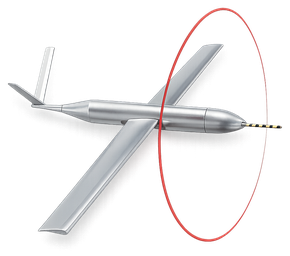
And a couple of criteria I've got, it needs to be a well-performing airplane and it needs to be kept affordable where companies that are just wanting to get into this type of operation can afford to do so. The initial design for the Osprey, I wanted something that would carry some weight and would be able to do it for a fairly long amount of time. So I came up with the streamlined fuselage and the high aspect ratio weight. Performance-wise, it performs extremely well.
We've flown it in 40-plus mile an hour winds on autopilot and it was able with the efficiency of autopilot, was able to maintain the tracking at the waypoints dead on and maintain altitude and everything. Even with the 40 mile an hour crosswind, it was able to do what we needed. We've been able to fly it in the essence of an hour. Yes, without trying to stretch it, I can go to high-performance batteries and motor setups and get well over that.
And again, it just goes into the efficiency of the design. It's just been a real good-performing airplane for us. It's a rugged airplane and it's done more than we could have asked for it. So I've been really happy with it.
So you're another wing guy. I know Gene has been. I mean, I know Gene, when you started with the wing, people were like, it'll never work. And, you know, we'll go in.
It all comes down to efficiency. I mean, the wings are efficient. A lot of people would say they'd never work for photography or video, but we've just proven that too. And again, some of the capabilities of autopilot are making an ideal platform for vertical photography.
So it's just the combination of the two just can't beat. Yeah, it's a really good combination all the way around. I agree. Well, you know, that's great.
Personally, I don't have much experience with wings, but, you know, the proof's in the pudding on that one. But, Chris, maybe you could talk a little bit about, you know, the autopilot and communications and whatnot. Maybe you could speak to that and kind of fill us in on the other half of this thing. Sure.
Where the autopilot spawned from was Dean was out there. He's had a lifelong dream to create something that could fly an aircraft autonomously. But the bigger issue was the cost of the current autopilots or the autopilots that were available at the time. They either were too expensive or did not do what he liked or asked for.
And in a lot of ways, it didn't do it as well as he believed it could be done. So Dean took a large leap and left Intel to pursue this business. And as I mentioned, we were fortunate enough to team up with Dean very early in the design process of the autopilot. Our input for the autopilot is primarily the flight physics and, you know, the way an aircraft flies in the aerodynamics standpoint.
Dean has, you know, many people do know about him, but he is probably one of the smartest individuals I've ever run across. And when he puts his mind to something, he will do it. All right. The autopilot was, you know, we were focusing on producing something that was within a price point that just about anybody could purchase and utilize for their own personal needs and or a possible business.
As the years went by, the first two years, there was not even any talk about proposed regulations or rules. It wasn't until later that people started catching light of what was going on and they decided, well, there's money to be made, therefore we need to regulate it. Regulation is a good thing and we don't have a problem with it, but the terms that they're putting across to us are very unrealistic in the sense that they're trying to make us follow manned aviation rules instead of something more similar to the remote control aircraft role.
Yeah. There's so many different forces at play on that one. That's another show. You know, we can, oh my God, go on about that one, but yeah, go ahead.
Sure. Well, you know, we're, you know, Dean and I like to think of ourselves as perfectionists and we really do not want to put anything out that isn't as close to our best ability as possible. Right. With that being said, Dean has consistently been updating and refining the autopilot and its code and its abilities.
As some may know, it's what we call a future queen. It has very little limitations and allows the end user to pretty much do whatever he thinks up. Now that is obviously within reason and within the physics side of how an aircraft flies and what it's capable of. So no magical stuff.
Yeah, you know, of course we get very unrealistic questions from individuals at times and needs that they want and we have to be sensitive about it, but we have to educate them on what the true abilities are that they're capable of achieving. Well, I think all of you guys could probably talk to that. I mean, I get it all the time. I've learned to be a better listener.
It may not show on the show, but I've learned to be a better listener and let people kind of explain what they think it can do. And, you know, I did a deal not too long ago. I had the whole company drill me for like three hours and they all had these different missions. And when I'm like, you know, that platform to do all of those missions doesn't really exist yet.
I'm not going to say it may not be out there in the future, but right now, no. So I'm sure you guys get the same kind of thing. We are way past the halfway point of our conversation. So I want to kind of move forward a little bit more.
And I did want to talk about the launch and recovery. Most folks probably know, like, let's say, you know, the ScanEagles touted as being launchable off the ship and recoverable off the ship. And they've got that super wedge launcher and the tetherball cable recovery. Let's talk about the Osprey and how this is accomplished.
First, we'll go with Jimmy and then Chris. Maybe we can talk about, you know, the autopilot's, let's say, piece of that. There's two ways you can launch the Osprey. One's hand launcher, of course, and the other one is with a bungee system, which is just a very simple, easy to set up bungee launch cord that we use to launch it with.
So it's actually very easy to launch, especially if you take off in assisted mode with autopilot. It makes it pretty much foolproof. Landing is still done manually. You need to belly land it or, as they do on the Sea Shepherd group, just land it in a, they've got a net.
If you ever watch the show when the helicopter takes off, it takes off from, it's actually kind of attached to a net that it releases to keep the aircraft stable on the deck. And they can raise that up and just fly it into it and capture it that way. And then Chris was talking to me earlier about it's got a bungee hook on it. And when it goes through the net, the hook that we use to bungee launch with actually snags the net and keeps it from coming back out.
So it's, again, it's, go ahead. Jimmy, just one question. Did you ever go in the water?
I didn't, that's something Chris will have to answer. He did the training for him. I'm not sure if it went in or not. We've had, as the testing goes, we've had a number of mishaps learning the abilities and limitations of the aircraft.
But as for that group, without saying too much, they, as far as we know, as far as they relate information-wise, there's been zero issues in regards to the launch and recovery of the aircraft. One of our initial concerns when we went to work with them was they have a vessel that's traveling, say, 15 knots. And they use the auto-launch procedure of autopilot. What we were concerned about is the individual not launching the vehicle with enough force behind it to kick the autopilot into gear.
And as you would expect, the aircraft would land on the water and then get ran over by the vessel. Fortunately, we've not run into that issue. And it seems like it's becoming a lesser of an issue as it goes on, primarily because of the forward velocity of the vessel and the slow flight speed that is required to get these aircraft aloft. As for recovery, Jimmy mentioned it is we have an assisted mode, two different assisted modes in the autopilot.
And what that does is allow the end user to fly the aircraft as he would traditionally. But it utilizes the autopilot's settings to restrict the aircraft from getting out of control or in a position where they can't recover it. So that's been very helpful in guiding the aircraft back to the vessel and recovering it. There's multiple ways to recover it, one being the net, the other literally being flying it right into your hands.
Again, that forward velocity makes a huge difference as opposed to standing on the ground in a dead wind environment. But yeah, we made the aircraft as waterproof as possible. I like to say more water resistant. If it did land in water of any type, they would, as long as they didn't run it over, they would be able to recover it.
And given autopilot is hermetically sealed, they wouldn't really have a problem with cleaning off the aircraft in continuing flights. So one of the questions that came to my mind while both of you guys were talking about this, and the hand catch and all the rest of that, give me a ballpark on the all-up weight of this system. Repeat that in, I didn't catch all that. Without giving away too much, what's the all-up weight of the Osprey system?
Okay, that particular system came in right at six pounds. Yeah, not particularly heavy, and for its size wingspan-wise, it's actually quite light. The Osprey is a great flying airplane. It flies very similar to a competition-type glider.
It can, as Jimmy mentioned, stay aloft for an hour plus. And one of the neat features of it is it does incredibly well at thermally. So if the individual sets the autopilot up properly, we have two types of flight methods, one being your standard flight controls of utilizing power to keep a specific speed. And then the other one is a blending method to allow it to essentially catch the thermals and back off of its power to reserve it for extended flight time.
That's pretty unique to autopilot. Yeah, that's a good capability. I don't know if either of you guys want to speak to this, and you can decline to comment, and as part of the consulting stuff that I do, I will talk to people about capabilities of their systems and price points. And you gave us a pretty good overview of the capabilities of this system.
Does anyone want to speak to price points, where it starts out, or would we decline the state? Sure. We initially started, as many know, with a thermopile setup. That was the version 2.0, and it actually started as the version 1.7, 1.8.
But there's limitations to the thermopiles in the respect of flying in rough weather conditions and or confusing it in some way. Say it's flying in a canyon or something to that effect. So we moved over to the IMU-based system, and that was about two years ago that we actually had something available to the public. And our goal was to essentially, I mean, there's no other way to put this.
We looked at the closest autopilot with the feature set that we had, and we literally cut the price in half. We don't make a huge amount of money on each one, but you sell more for less is kind of the thought process behind it. Now that the ITAR situation and the lack of regulations in the US have kicked in, it's limited our sales specifically in the United States. And in a lot of cases, we may have been better off charging a larger amount or what we consider the value of the system is.
On the other hand, it's a lot easier to bring a price down than to raise it. So we continue, instead of increasing prices, putting them out of reach of your average individual, we add features and advancements in the system that legitimately justify the cost increase. So, you know, initially, Dean was trying to build a sub $1,000 system that was available to anybody and had the abilities of your $5,000 or $6,000 autopilot. Obviously, reality struck in multiple different ways, and it had to be increased a bit.
But we are still within half the price of our closest competitor. So some were crowded. Okay, and what did that start off at, or did you not want to say?
Yeah, we didn't no longer sell the thermopile version, mostly due to the availability of the analog thermopile sensors. But the IMU system is a six degree of freedom system, and it has multiple features, data logging, and various trigger sequences that you can input. And the price point right now is at $3,100. So we let a bang for the buck, actually, it sounds like.
Absolutely, yeah. Without me specifically naming off other individuals or other autopilots, you know, we basically purposely went out there to cut that price in half. And we gained a lot of customers because of that, but we also allowed the other companies some room to advance their systems and start pushing other customers. Right, right.
And Jimmy, what do you, are you selling all up systems, or are you just selling airframes? What's going on with the hangar team?
We sell the all up systems. We use autopilot, of course, for the autopilots when we have a full up system. But the airframe itself, because I don't use a lot of exotic materials, as in Kevlar and carbon, I try to keep the fiberglass content up as much as I can. Of course, we do use those materials where we need to, but we end up with reflectivity issues and interference with the radio systems and whatnot.
So I try to keep to a minimum, so let me keep my price down. So the Osprey airframe itself starts at $900. Wow. That's not too bad at all.
Okay, well, one thing I want to do, because we're closing in on the five-minute warning, and there's a couple more things I want to ask. But what I'm going to do is this is, you know, I'm just dying to pet the pooch over here. So what I'm going to let you guys do is, you know, let's start with Jimmy. You want to give your website address.
Sure, it's hanger18uav.com. Okay. And Chris?
Yeah, we've got a couple websites and our own forums, similar to the RC groups type forums or DIY drones. But our website is apto, A-T-T-O, Pilot International, alloneword.com. And you can go on there, and there's various links to contact the individuals in the company and or all of them at the same time. In addition to that, we have a website that Gary Mortimer has graciously set up for us and been running, and that is the aptopilot.ning website, which is a forum for our end users and people who are looking for assistance that need information.
All right, well, that's good. And then again, if as the listener you didn't get that, you can always email us at suasnews.com, Patrick at suasnews.com, and we could forward that information on to you. I know that autopilot is an advertiser, so you're going through there. So you could also click on that on the home page.
Okay, and you know, we kind of touched on a lot of stuff, and I wanted to circle back and talk about the congressional mandates and all the rest of that, but it looks like we're going to run out of time on that. So one other question I wanted to ask is does anyone know when that episode is going to air, or is it an ongoing thing where they're using the RPA or?
They will not specifically show it, and there's multiple reasons behind it. But they do hint across the fact that they have some new technology that is helping them assist or assist them in accomplishing their goal. As far as we are aware, it's an ongoing series of TV shows, and it's only a certain part of the year, obviously, more towards the season of the whaling and various tests that they take on. Okay, Jimmy, did you want to?
Once again, June 1st is when the series starts again. Okay, but they're going to probably kind of keep this under wraps, it sounds like, but we know it's there. It's out there, and it's continuing, and whatever else. It would be interesting to know in the future what type of impact you guys have again without giving away too much.
Over at SUASnews.com, we'd be happy to receive some of these press releases in the future about the exploits of the Osprey and the collaboration with the autopilot. So be sure and send that out to us. The other thing is I've got to do a little bit more housekeeping. Gene, did you have anything to add real quick?
No, you can't beat the autopilot and the wing. As far as I'm concerned, I've been through four systems, and it's a good combination. Jimmy's got a good combination there with it, and I think they're going to have a lot of success with that system. Well, I've got to tell you, I'm pretty impressed when I heard all of the capabilities and the price points.
Again, I think as soon as this thing breaks loose, these things should be selling like hotcakes, lots of capabilities for a little bit of money. Anyway, the housekeeping part of this, to the listeners, it's been very popular. I can't believe how many downloads we had last week's podcast with Gene, the inaugural. I've heard a lot of good feedback.
I'd like to ask the listeners to email their topics of interest, shows they'd like to hear to patrick at suasnews.com. We're going to do driverless cars next week, and that ought to be pretty interesting. I'm looking forward to that. I'd also like to say we're still looking for a sponsor for the podcast, and you want to get the word out on your company's good services.
This is an excellent vehicle to do that. Again, email me at patrick at suasnews, and we'll go from there. Everybody, hey, thanks a bunch. Thank you.
Absolutely. Hopefully we can do this again in the near future. All right. Talk to you guys later.
All right. Have a good day.